
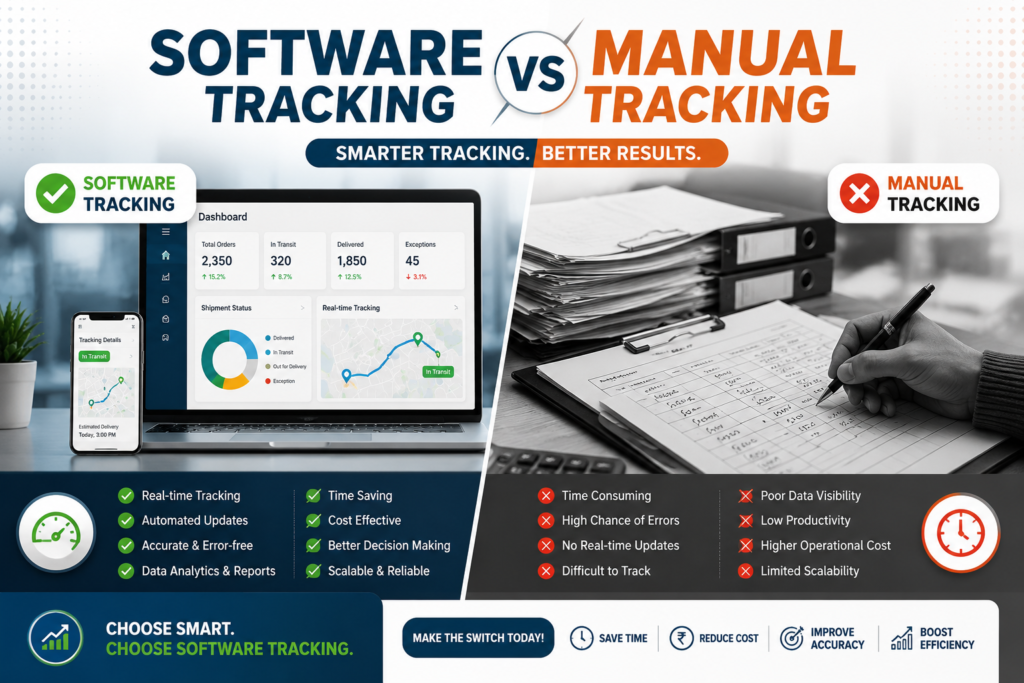
Software vs Manual Tracking
Managing field employees efficiently is one of the biggest challenges for businesses operating in industries like pharma, sales, logistics, healthcare, and service management. Many organizations still rely on traditional methods such as phone calls, spreadsheets, paper reports, and WhatsApp updates to monitor their teams. However, with growing operational demands, businesses are now shifting toward smarter solutions like field staff tracking software.
When comparing manual vs software tracking, the difference in efficiency, accuracy, and business performance becomes very clear. Modern businesses require real-time visibility, faster reporting, and better workforce management tools to stay competitive.
Manual Tracking Limitations
Traditional tracking methods may seem simple, but they create several operational challenges that directly affect productivity and profitability.
Lack of Real-Time Visibility
Manual systems do not provide live employee updates. Managers often have no idea where field employees are during working hours. This lack of visibility makes it difficult to monitor productivity or assign urgent tasks.
High Chances of Errors
Manual reporting depends heavily on human input. Employees may forget to update information, provide inaccurate details, or delay reporting. These errors can create confusion and impact business decisions.
Attendance Manipulation
Without proper verification, attendance records can easily be manipulated. Employees may mark false attendance or submit inaccurate task updates, reducing accountability.
Time-Consuming Process
Collecting reports through calls, messages, or spreadsheets takes significant time. Managers spend hours verifying data instead of focusing on business growth and operational improvement.
No Centralized Data
One of the biggest disadvantages of manual systems is scattered information. Data is spread across different platforms, making it difficult to analyze employee performance or generate reports.
These limitations show why traditional methods are no longer suitable for modern businesses managing large field teams.
Software Advantages
Modern field workforce management tools eliminate the inefficiencies of manual tracking and provide businesses with complete operational control.
Real-Time Employee Tracking
A reliable field force tracking software uses GPS technology to provide real-time employee location updates. Managers can instantly monitor field activities and improve coordination.
Automated Attendance System
Geo-fenced attendance systems ensure employees mark attendance only from authorized locations. This reduces fraud and increases transparency.
Centralized Dashboard
All employee information, attendance records, reports, and task updates are available on a single dashboard. This improves operational visibility and simplifies workforce management.
Real-Time Reporting
Automated reporting systems generate instant reports, helping managers make faster and more accurate decisions.
Improved Accountability
Employees tend to perform more responsibly when their work activities are tracked systematically through software.
Scalability
Unlike manual systems, workforce management software can efficiently handle both small and large teams. Businesses can easily scale operations without increasing management complexity.
Compared to traditional methods, software provides better accuracy, efficiency, and operational control.
Cost vs ROI
Many businesses assume manual tracking is cheaper than software solutions. However, this assumption often ignores the hidden operational costs associated with manual systems.
Hidden Costs of Manual Tracking
Manual systems increase business expenses in multiple ways:
- Time spent collecting and verifying reports
- Productivity losses due to inefficient monitoring
- Increased travel and fuel costs
- Delayed decision-making
- Errors leading to operational inefficiency
These hidden costs gradually impact overall profitability.
Software Investment Delivers Long-Term Value
A modern field staff tracking software may require an initial investment, but the long-term benefits significantly outweigh the costs.
Businesses using tracking software experience:
- Reduced operational expenses
- Improved employee productivity
- Better route planning
- Faster reporting and decision-making
- Improved customer service
ROI Comparison
When comparing employee tracking comparison metrics, software clearly delivers higher returns on investment. Businesses often see measurable improvements in efficiency, transparency, and cost savings within a short period after implementation.
Business Impact
The tracking method a business chooses directly affects its operational performance and growth potential.
Impact of Manual Tracking
Businesses relying on manual systems often experience:
- Low productivity
- Delayed communication
- Poor employee visibility
- Lack of accountability
- Higher operational inefficiencies
Impact of Field Staff Tracking Software
Organizations using modern field workforce management tools gain several competitive advantages:
- Real-time operational visibility
- Improved team productivity
- Faster business decisions
- Better employee accountability
- Enhanced customer satisfaction
In today’s competitive business environment, companies cannot afford inefficient workforce management processes.
Why SHOTRACK is the Smarter Choice
SHOTRACK is designed to help businesses replace outdated manual systems with a smarter and more efficient workforce management solution.
As a complete field staff tracking software, SHOTRACK offers powerful features that simplify field workforce operations.
Key Features of SHOTRACK
- Live GPS employee tracking
- Automated attendance management
- Route tracking and travel monitoring
- Real-time reporting system
- Centralized management dashboard
- Task and activity monitoring
How SHOTRACK Helps Businesses
SHOTRACK improves workforce visibility, eliminates manual reporting processes, and increases employee accountability. Managers can monitor activities in real time and make data-driven business decisions quickly.
As a reliable field force tracking software, SHOTRACK helps businesses improve operational efficiency, reduce costs, and scale operations smoothly.
Conclusion
Manual tracking methods may have worked in the past, but they are no longer effective for modern business operations. Businesses today require speed, accuracy, real-time visibility, and better workforce control.
A modern field staff tracking software provides far greater efficiency compared to traditional tracking methods. When comparing manual vs software tracking, software clearly offers better productivity, lower operational costs, and improved decision-making capabilities.
By adopting advanced field workforce management tools like SHOTRACK, businesses can streamline operations, improve employee performance, and gain a strong competitive advantage in the market.