
Your cart is currently empty!
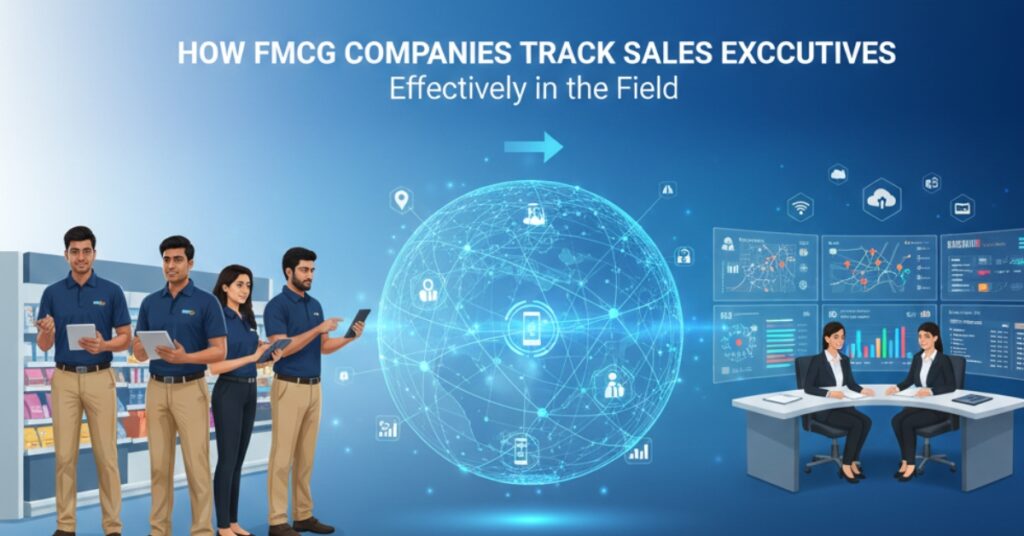
How FMCG Companies Track Sales Executives Effectively in the Field
Introduction
Fast-Moving Consumer Goods (FMCG) companies live and die by execution in the field. While brand strategy, pricing, and distribution matter, real success depends on what happens at kirana stores, supermarkets, and retail counters every single day. This makes the FMCG sales executive one of the most critical assets in the organization.
Yet, many FMCG companies struggle to answer simple questions:
Are all beats being covered consistently?
Are sales executives spending enough time in the market?
Which routes are efficient—and which are not?
Is reporting accurate or just routine paperwork?
To solve these challenges, FMCG organizations are increasingly adopting FMCG field sales tracking solutions that bring clarity and control without disrupting on-ground execution.
Why Tracking FMCG Sales Executives Is Challenging
FMCG field operations are complex because:
Sales executives cover large geographies
Daily routes change based on demand
Outlet density varies across regions
Supervisors manage multiple reps simultaneously
Without proper sales executive tracking, companies depend heavily on verbal updates and end-of-day reports—both of which lack reliability.
The Role of FMCG Field Sales Tracking
Effective FMCG field sales tracking focuses on three core areas:
Presence – Is the executive actually in the field?
Coverage – Are planned outlets being visited?
Movement – Is time spent productively?
Tracking movement and location answers these questions objectively.
Route Tracking for FMCG Sales Teams
Poor routing leads to:
Missed outlets
Fatigue
Lower daily coverage
Wasted fuel and time
Route tracking for FMCG sales helps companies:
Identify inefficient travel paths
Optimize daily beat plans
Balance workload across territories
This results in more outlet visits per day without increasing pressure.
Improving Beat Planning and Coverage
Beat plans are only effective if executed properly. Tracking helps managers:
Verify beat adherence
Identify uncovered areas
Reduce overlap between executives
With better beat planning and coverage, FMCG companies ensure market presence remains consistent.
Retail Outlet Visit Tracking Without Micromanagement
Traditional outlet tracking often involves:
Manual visit logs
Photo uploads
Excessive check-ins
Modern retail outlet visit tracking focuses on location presence and movement patterns—reducing manual work while maintaining accountability.
Accurate Field Sales Reporting for FMCG
Manual reports are prone to:
Delay
Inflation
Inconsistency
Automated field sales reporting for FMCG ensures:
Timely data
Location-backed activity logs
Reliable performance summaries
Managers can now review data instead of chasing reports.
Sales Productivity in FMCG Improves with Visibility
When sales executives know that:
Field time is visible
Coverage is tracked objectively
Performance discussions are data-based
Discipline improves naturally. This directly boosts sales productivity in FMCG without hurting morale.
Why Lightweight Tracking Works Best for FMCG
FMCG sales teams need:
Fast apps
Minimal manual input
Low battery usage
Simple reporting
Heavy systems slow them down. This is why FMCG companies prefer focused tracking tools over complex force-automation platforms.
ShoTrack’s Fit for FMCG Sales Teams
ShoTrack enables FMCG organizations to:
Track field movement
Monitor coverage patterns
Generate simple, usable reports
It avoids unnecessary complexity, making it easier for large FMCG teams to adopt and sustain.
Conclusion
Effective FMCG execution depends on visibility—not micromanagement. By adopting smart sales executive tracking, companies ensure better coverage, improved productivity, and reliable reporting.
With lightweight tools like ShoTrack, FMCG organizations can finally align strategy with on-ground execution.